
AI Strategy Consulting for Startups: A Practical Guide for Founders
Author: Kari Escobedo, Fractional CIO/CTO - FinUp Partners

Key Takeaways:
- A successful AI strategy for startups requires tying every initiative to specific, measurable business outcomes—such as revenue growth or operational efficiency—rather than chasing the latest technology trends.
- Rapid, focused pilots using existing data and vendor tools can deliver ROI in weeks, not months, allowing startups to prove value before investing heavily in custom solutions or infrastructure.
- Strong governance and experienced leadership from day one are critical; fractional CAIO services provide startups with the strategic direction and operational expertise needed to avoid common pitfalls and scale AI initiatives responsibly.
MIT research shows 95% of AI pilots fail to deliver ROI. Most startups chase trends instead of aligning AI with revenue goals. Smart AI strategy consulting for startups focuses on fast pilots that prove value in weeks, not months. Explore FinUp Partners' Fractional CAIO Services for proven AI leadership.
Build a Practical AI Roadmap That Drives Measurable Growth
Most founders get stuck chasing AI trends instead of business impact. A practical AI strategy for startups starts with clear outcomes, not technology for its own sake. Here's how to build a roadmap that ships value in weeks, not months.
Start With Two Clear Business Wins
Pick one revenue opportunity and one efficiency gain. Revenue wins might include personalized recommendations or automated lead scoring. Efficiency wins could be customer support automation or invoice processing. Target a 4-week pilot for each with specific KPIs like conversion rate lift or hours saved per week.
Use Your Existing Data First
Once you've identified your wins, stop waiting for perfect data infrastructure. Augment what you have with vendor APIs and lightweight tools before building custom models. Most startups can prove AI value using existing customer data, transaction logs, and third-party services. Save the heavy data engineering for after you've proven ROI.
Follow a 16-Week Runway Plan
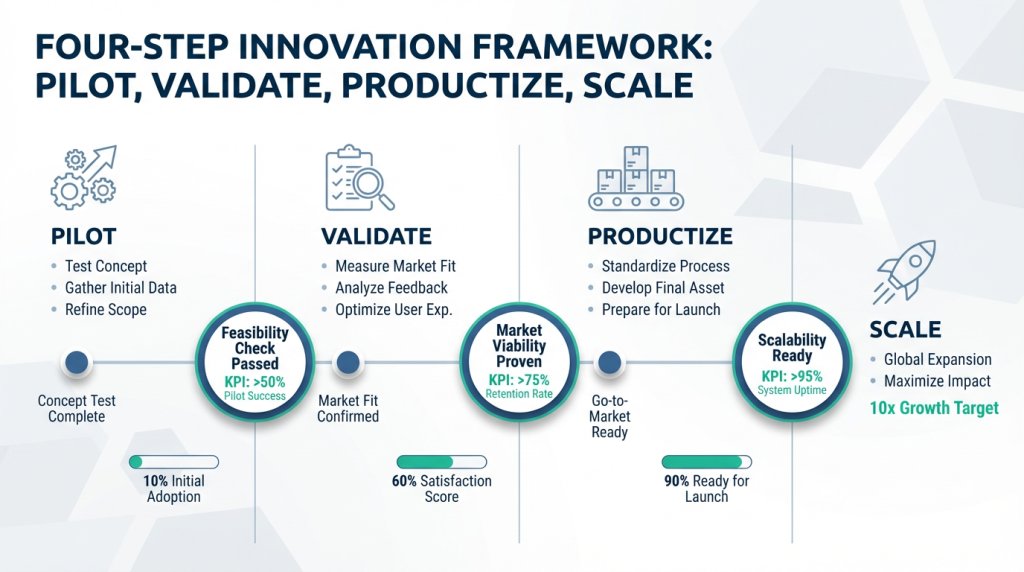
Structure your approach: Pilot (weeks 1-4), Validate (weeks 5-8), Productize (weeks 9-12), Scale (weeks 13-16). Set hard exit criteria for each phase, like less than 20% accuracy improvement equals pivot or kill. If your pilot doesn't hit target metrics by week 4, move on. The NIST AI Risk Management Framework provides governance checkpoints, while proven AI pilot programs show how to scale successfully.
Avoid the Most Common AI Strategy Mistakes Startups Make
Smart founders learn from others' expensive mistakes. After working with dozens of startups, these common AI strategy mistakes show up repeatedly. Here's what to watch out for and how to stay focused on results that matter.
- Chasing novelty over business impact. Don't greenlight any AI project without a clear metric tied to revenue or costs. MIT research shows successful AI leaders measure projects by business KPIs like LTV/CAC improvement or cycle time reduction, not model accuracy scores.
- Overbuilding data infrastructure too early. Before investing in expensive platforms, prove lift with scrappy tooling first. Startup spending data shows companies get better ROI from application-layer experiments than heavy infrastructure builds in early stages.
- Skipping governance and security from day one. Even small pilots need proper controls. Implement role-based access, PII masking, and human-in-the-loop review processes immediately. The NIST AI Risk Management Framework provides practical checklists for transparency, monitoring, and risk management that prevent costly compliance issues later.
- Setting unrealistic automation targets. Cap automation at 60-70% of any process until you've proven quality gates work. Full automation sounds appealing, but creates brittle systems that break when edge cases appear.
- Hiring AI talent before proving use cases. Resist the urge to hire machine learning engineers or data scientists until you've validated demand with vendor APIs and no-code tools. Talent is expensive and hard to retain without clear project direction. Consider fractional CAIO leadership to guide strategy before committing to full-time hires.
AI Strategy Consulting FAQs for Early-Stage Teams
Founders often struggle to separate AI hype from practical implementation. Here's what actually works when building AI strategy that delivers measurable results, based on real operator experience with venture-backed companies.
How can startups build a practical AI strategy that drives measurable growth?
Tie each AI initiative to one specific KPI and assign a single owner. Launch focused pilots with pre-set pass/fail thresholds before committing to larger investments. Focus on initiatives that directly impact revenue or reduce operational costs by at least 15%.
What are the most common mistakes startups make with AI strategy consulting?
Hiring for custom models too early and skipping governance frameworks. Start with partial automation to test quality and user acceptance before full deployment. Many startups also chase trendy AI applications instead of solving real business problems that affect their bottom line.
How do you evaluate the ROI of AI strategy consulting for early-stage companies?
Use this simple formula: incremental gross profit or cost savings over 16 weeks minus total program cost, divided by program cost. For instance, if an AI pilot saves $10K monthly and costs $15K total, your ROI is 67% with a 1.5-month payback. Require payback in under two quarters.
When should startups hire fractional AI leadership versus building internal teams?
Hire fractional leadership when you need strategy and governance but lack the budget for a full-time executive. Build internal teams only after proving AI value through pilots. Most startups need strategic direction before they need dedicated AI engineers.
How long does it take to see results from AI strategy consulting?
Well-structured AI pilots should show measurable results within 45 days. Full implementation typically follows a quarterly implementation cycle from strategy to scaled deployment. Any consultant promising overnight transformation or requiring six-month commitments upfront should concern you and indicate poor planning.
Get Results Fast: Next Steps and How We Help
Start this week by picking one customer-facing use case and one internal automation opportunity. Define clear KPIs for each and scope a 45-day pilot with measurable success criteria. This focused approach lets you prove ROI before committing to larger investments.
To execute this strategy effectively, most founders need experienced leadership without the overhead of a full-time hire. FinUp Partners provides fractional CAIO services for startups that implement an AI strategy aligned with your revenue plan, establish responsible governance from day one, and ship pilots that actually convert to business value. Our operators bring proven frameworks from Fortune 100 companies, adapted for startup speed and budget constraints.Ready to ship AI pilots that drive real results? Explore FinUp Partners' Fractional CAIO Services today.