
Fractional CFO for Startups: What Founders Need to Know Before Their Next Raise
Author: Carla Anderson Skogland --

Key Takeaways:
- A fractional CFO brings Fortune 100-level financial discipline and investor-readiness to startups, enabling them to tell a compelling, data-driven growth story that attracts funding.
- Implementing a structured 84-day pre-raise plan with a fractional CFO ensures your financials, data room, and narrative are investor-ready—reducing fundraising delays and increasing your chances of closing a successful round.
- Fractional CFOs offer a cost-effective, flexible alternative to full-time hires, delivering strategic finance leadership exactly when startups need it most—without the long-term commitment or overhead.
Most fundraising efforts stall not because the product lacks potential, but because the financial story is incomplete or inconsistent. Investors see scattered metrics, weak assumptions, and missing cash flow projections. They pass on deals with unclear financial narratives, leaving founders wondering what went wrong.
Here's what works: A seasoned fractional CFO for startups can turn your next raise into a fundraising strategy within 84 days. They tighten your model, sharpen your narrative, and build an investor-ready data room that tells a compelling growth story. Talk to FinUp Partners about getting investor-ready with fractional CFO expertise that keeps you fundable and protects your runway.
What a Fractional CFO Actually Does for Startups
Most founders can tell you their monthly burn rate, but ask them how a 20% price increase affects their 18-month runway, and you'll get blank stares. When founders ask what a fractional CFO for startups actually does, the answer transforms financial guesswork into investor-ready precision by building the systems, models, and discipline that fast-growing companies need to scale without burning through cash or losing investor confidence.
Builds Driver-Based Models That Ground Every Decision in Data
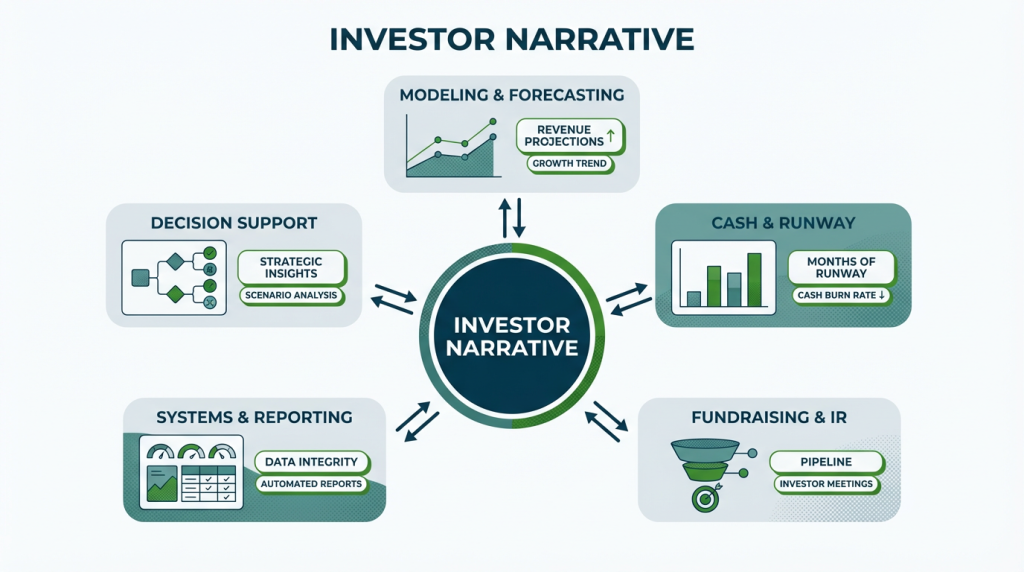
Your fractional CFO creates a comprehensive 36-month forecast tied directly to your business drivers like pipeline conversion, pricing changes, headcount plans, and unit economics. Instead of wondering if you can afford two more developers, you see precisely how hiring them in Q2 versus Q4 affects your Series A timeline and runway. Here's what works in practice: driver-based models that show how each variable impacts your growth trajectory. According to KPMG's startup CFO guidance, building these forecasting capabilities is one of the most immediate priorities for startup finance leaders.
Shapes Your Financial Narrative for Investor Readiness
Past the spreadsheets, your fractional CFO crafts the financial story that investors need to hear. They pressure-test your assumptions, identify potential red flags before investors do, and package everything into board-ready reporting and a clean data room. For example, they'll model how your customer acquisition cost trends affect unit economics at scale, then present it in formats investors recognize and trust. SVB research shows that professionalizing financial reporting and analytics is what separates fundable startups from those that struggle to close rounds.
Implements Cash Controls and Weekly KPI Discipline
Your fractional CFO puts runway protection first by implementing cash flow controls, scenario planning, and weekly KPI reviews. You get weekly dashboards showing burn rate, customer acquisition costs, and milestone tracking so every spending decision is intentional. Here's what this looks like: automated alerts when burn exceeds plan, scenario models for different growth rates, and KPI reviews that connect spending to revenue outcomes. Industry research confirms that this treasury discipline and growth-focused financial management is what investors demand to see from startups preparing for their next funding round.
Preparing for Fundraising: The 84-Day Pre-Raise Plan
Most fundraising efforts stall because founders approach investors with incomplete financials, inconsistent metrics, or a story that doesn't hold up under questioning. A structured 84-day preparation timeline eliminates these failure points and positions your startup to close faster and on better terms.
- Days 1–14: Foundation and Story. Audit your books, clean up accounting inconsistencies, and lock down your data model. Define your market story, ideal customer profile, pricing logic, and key proof points like customer logos, cohort retention, and unit economics that investors will evaluate during due diligence.
- Days 15–56: Models and Metrics. Build a driver-based 36-month forecast with sensitivity scenarios for best, base, and worst cases. Create board-grade reporting that tracks your key metrics weekly and rehearse investor Q&A sessions to tighten your narrative around growth assumptions and market opportunity.
- Days 57–84: Data Room and Outreach. Assemble a comprehensive data room with all financial documents, legal agreements, and operational metrics. Finalize your target investor list and run a disciplined outreach process with weekly pipeline reviews to track meetings, follow-ups, and next steps.
- Timeline Reality Check. Most fundraising processes take 2-3 months from first pitch to closed round. Starting this 84-day prep work before you officially launch gives you the runway and confidence to negotiate from strength rather than desperation.
- Diligence Ready. Investors will request everything from cap tables to customer contracts during Series A diligence. Having these documents organized and your financial story rock-solid means faster closes and fewer last-minute surprises that derail momentum.
Fractional CFO vs. Full-Time CFO: Costs, Tradeoffs, and When to Hire
The benefits of hiring a fractional CFO versus a full-time CFO for a startup come down to speed, cost, and scope flexibility. Here's how your finance leadership options stack up when you're preparing for your next raise.
Here's the reformatted version:
Typical Monthly Cost
- Fractional CFO (Lightweight): $8,000–$15,000
- Fractional CFO (Embedded): $15,000–$25,000
- Full-Time CFO: $25,000–$50,000+
- Controller + Advisor: $12,000–$20,000
- DIY + Bookkeeper: $2,000–$5,000
Scope & Fit
- Fractional CFO (Lightweight): Strategic finance, board reporting, fundraising support
- Fractional CFO (Embedded): Full CFO scope, team leadership, investor relations
- Full-Time CFO: Complete ownership, daily leadership, long-term strategy
- Controller + Advisor: Accounting + periodic strategic input
- DIY + Bookkeeper: Basic books, founder-led finance
Speed to Impact
- Fractional CFO (Lightweight): 2–4 weeks
- Fractional CFO (Embedded): 1–2 weeks
- Full-Time CFO: 3–6 months
- Controller + Advisor: 4–8 weeks
- DIY + Bookkeeper: Immediate
Best For
- Fractional CFO (Lightweight): Pre-Series A companies, seasonal projects, specific initiatives
- Fractional CFO (Embedded): Series A–B stage, rapid scaling phases, complex fundraising
- Full-Time CFO: Series B+ companies, public company prep, complex operations
- Controller + Advisor: Steady growth stage, compliance focus, basic reporting needs
- DIY + Bookkeeper: Very early stage, simple business models
Key Risks
- Fractional CFO (Lightweight): Limited availability, scope creep
- Fractional CFO (Embedded): Higher investment, integration challenges
- Full-Time CFO: High compensation, equity dilution, hiring risk
- Controller + Advisor: Gap in strategic finance, limited fundraising experience
- DIY + Bookkeeper: Founder bandwidth, investor credibility risk
Research shows that startups should consider Full-Time CFO leadership when complexity, scale, and investor expectations demand daily oversight. For most pre-Series B companies, the fractional model delivers proven senior expertise without the overhead, giving you operator-level guidance precisely when your business needs it.
Fractional CFO for Startups: Frequently Asked Questions
Founders preparing for their next raise often have specific questions about timing, scope, and what investors actually expect. These fractional CFO for startups FAQ answers help you move forward with confidence.
When should a startup consider bringing on a fractional CFO?
Most startups benefit from fractional CFO support when they hit $1M+ in annual revenue or are 6-12 months out from their next funding round. You need this level of financial leadership when your bookkeeper can't build forecasts, your controller doesn't understand unit economics, or investors start asking questions you can't answer with confidence.
How is a fractional CFO different from a controller or an outsourced accounting firm?
Controllers handle transactions and compliance—they record what happened. Fractional CFOs focus on what's next. They provide strategic guidance, not just transaction processing. They build driver-based forecasts, shape your financial narrative for investors, and help you make decisions about pricing, hiring, and cash management.
What should be included in an investor-ready data room and board reporting pack?
Your data room needs clean financials, 36-month forecasts, cap table details, and key contracts. Board packs should include KPI dashboards, cohort analysis, and unit economics. The YC checklist covers the full scope, though founders should focus on consistency and defensible assumptions that tell their growth story.
How long does it take to get fundraising-ready with a fractional CFO?
With the right fractional CFO, you can have investor-ready financials and a solid data room within 84 days. The first month focuses on cleaning up your books and building the model. Months two and three involve stress-testing assumptions, preparing board materials, and rehearsing your pitch.
What's the typical cost difference between fractional and full-time CFOs?
Fractional CFOs typically cost $8K-$25K per month, depending on scope and involvement. Full-time CFOs at the startup level run $200K-$350K annually plus equity. The fractional approach gives you senior-level expertise immediately without the long-term commitment, making it perfect for fundraising sprints. Experienced operators from companies like FinUp Partners bring Fortune 100 financial discipline at startup speed.
Scale Smarter Before Your Next Raise
Your next fundraising round depends on more than a great product. Investors expect clean financials, defendable projections, and clear metrics that prove your business can scale profitably. A fractional CFO brings the operator-level expertise to build that financial foundation without the cost or commitment of a full-time hire.
That's where experienced fractional CFO services make the difference. FinUp Partners delivers proven finance leaders who stabilize your cash flow, create investor-ready models, and execute disciplined fundraising processes. You get Fortune 100 expertise at startup speed, so your team stays focused on building while your financial story becomes bulletproof for investors. Ready to turn your next raise into an execution plan? Connect with FinUp Partners about fractional CFO services.