
How Much Does a Fractional CMO Cost? Real Numbers and What Drives the Price
Clearly define deliverables, transparent pricing, and alignment with measurable growth outcomes
Author: Mary Schimmelman, Fractional CPO/CMO/CCO, FinUp Partner

Most startups pay between $10,000 and $25,000 per month for fractional CMO services. The wide range reflects differences in experience level, engagement scope, and the complexity of growth challenges. A seed-stage company building its first marketing function pays far less than a Series B startup preparing for IPO with board-level reporting needs.
The real question isn't just how much does a fractional CMO cost, but what drives those price differences. Sprint-based projects for specific launches differ from ongoing retainers that include team leadership and investor updates. FinUp Partners connects startups with real operators who price transparently based on measurable outcomes rather than billable hours, helping you understand exactly what you're paying for and why.
Baseline Costs And Rate Structures
That $10,000-$25,000 monthly range breaks down into predictable patterns once you understand what drives fractional CMO rates. Here's what we see in practice: scope, seniority, and urgency determine where you land in that spectrum.
What's the typical monthly retainer range and what shifts the price?
Most fractional CMO rates fall into three tiers: $8,000-$12,000 for junior-level support, $12,000-$20,000 for experienced operators, and $20,000-$30,000+ for senior executives with Fortune 500 backgrounds. Coastal markets run 25-30% higher than remote arrangements. The rate jumps when you need board-ready reporting or fundraising support.
When do hourly rates make sense versus retainers?
Hourly rates ($200-$500) work for one-off strategy sessions or audits. Day rates ($1,500-$3,500) suit intensive workshops or campaign launches. Retainers deliver better value for ongoing work because you get consistent attention and relationship building. Here's what works: use hourly for testing fit, then move to retainer for execution.
What pushes rates into the $20,000+ territory?
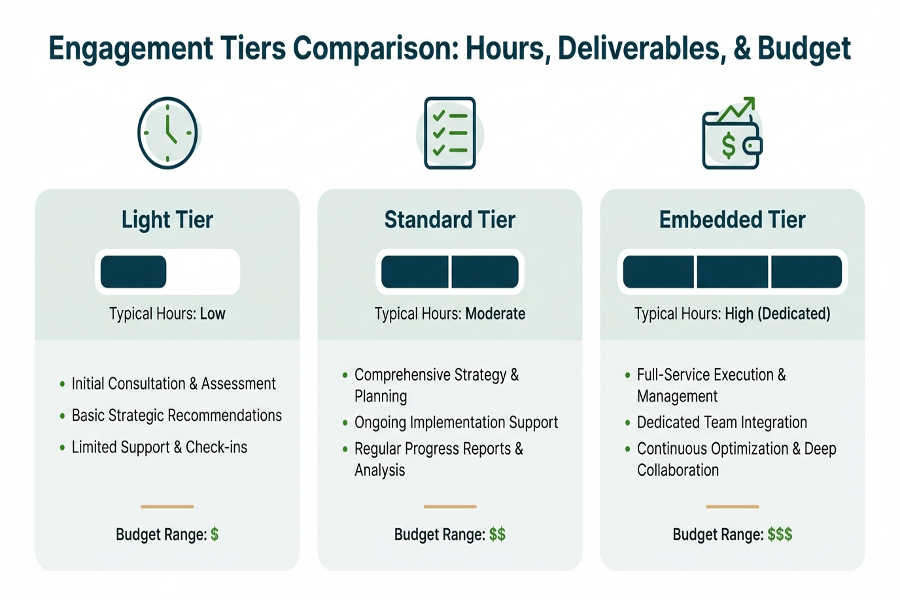
High-stakes situations drive premium pricing: preparing for Series A, managing $500K+ marketing budgets, or leading teams through rapid scaling. Senior operators who've built marketing functions at scale charge more because they prevent expensive mistakes. Embedded roles requiring 60+ hours per month also hit premium rates.
Are performance fees worth considering?
Performance fees are uncommon but increasing among growth-stage companies. Typical structure: 10-20% bonus tied to specific metrics like qualified leads or pipeline value. They work when goals are measurable and within the CMO's control. Avoid performance fees tied to broad revenue targets—too many variables outside marketing's influence create misaligned incentives.
Do fractional CMOs take equity?
Equity happens mainly in 12+ month engagements where the CMO is building the function from scratch. Typical ranges: 0.1-0.5% for advisory roles, 0.25-1.0% for embedded leadership. One-year cliff with monthly vesting is standard. Most fractional arrangements focus on cash compensation because the engagement timeline doesn't align well with equity vesting schedules.
Red flag: proposals that don't specify what's included. Retainers should cover strategy and execution oversight, but media spend, tools, and contractor costs typically run separate. Ask upfront about resources and templates included in the engagement.
Engagement Models, Scope, And What You Actually Get
When you're preparing for a funding round, you need to know exactly what you're buying and how fast you'll see results. Here's what different fractional CMO engagement models deliver in practice, based on what we've seen work across dozens of scaling startups.
What does a 16-hour versus 65-hour monthly engagement actually deliver?
At 16 hours monthly, your fractional CMO focuses on strategy and high-level guidance - think messaging frameworks, channel prioritization, and coaching your existing team. You'll get clear direction but handle most execution internally. At 65 hours, they're running your marketing operations daily, managing campaigns, and directly contributing to pipeline growth. The difference shows up fast in your conversion rates and lead quality.
What's included in your retainer versus what costs extra?
Your monthly retainer covers strategy, team management, reporting, and hands-on campaign work. Media spend, design work, marketing tools, and freelance contractors are separate costs. Plan for these add-ons to run 40-60% of your retainer fee. Smart fractional CMOs help you optimize this spend rather than just approving every tool request.
Should you choose project sprints or ongoing retainers for fractional marketing leadership?
Project sprints work well for defined deliverables like go-to-market strategy or campaign launches. You'll pay $20k-45k upfront with clear timelines and handoffs. Ongoing retainers build deeper knowledge of your business and provide consistent pipeline support. Most startups approaching Series A benefit more from retainers because fundraising requires sustained momentum, not one-off projects.
How do seed-stage and Series A/B scopes differ in cost and focus?
Seed-stage work centers on messaging, early channel testing, and basic funnel setup. Budget $10k-18k monthly for this foundation-building phase. Series A/B engagements include pipeline management, board-ready reporting, and team scaling support, running $20k-35k monthly. The jump reflects increased complexity and the need for proven systems that scale during rapid growth phases.
Does it cost more to lead an existing team or build marketing from scratch?
Leading an existing team typically costs 25% less because processes and relationships are established. Building from scratch requires more hours for hiring, tool selection, and system creation. Expect 4-6 months to see full results when building new marketing functions versus 6-8 weeks when optimizing existing teams. Factor in recruitment costs and initial tool investments when budgeting for new builds.
Value, ROI, And Full-Time Comparisons
Smart founders want proof their investment pays off before committing to any leadership hire. These questions help you judge real value and avoid expensive mistakes before you sign.
How does fractional CMO vs full-time CMO cost compare annually?
A full-time CMO at a venture-backed company typically costs $300K-$500K annually when you include salary, bonus, benefits, and equity. According to The Conference Board's 2024 data, median total compensation often exceeds these ranges. A fractional CMO runs $120K-$300K annually depending on scope, delivering senior expertise without the overhead or long-term commitment.
What ROI indicators should I see within 90 days?
Look for measurable improvements in pipeline quality, lead-to-opportunity conversion rates, and cost per acquisition. SaaS benchmarks show top performers achieve 15-25% better conversion rates and lower customer acquisition costs. Your fractional CMO should deliver clearer messaging, optimized funnels, and predictable lead flow that directly impacts revenue within the first quarter.
Can I tie fractional CMO fees to performance outcomes?
Yes, but structure it carefully. Tie 20-30% of fees to leading indicators like qualified pipeline generation or conversion improvements rather than lagging metrics like closed revenue. Harvard Business Review emphasizes avoiding short-term incentives that sacrifice sustainable growth. Focus on metrics the CMO directly controls while maintaining base compensation for strategic work and team building.
What signals suggest I'm overpaying for strategy without execution?
Red flags include endless strategy decks without implementation, lack of hands-on campaign management, or no knowledge transfer to your team. You're overpaying if your fractional CMO can't show you the systems they're building or train your people to run them. Real operators roll up their sleeves and leave you with processes that work without them.
Which proposal red flags indicate poor value?
Avoid vague scope, missing KPIs, or tool lock-ins. Quality fractional CMOs specify deliverables, timeline milestones, and measurable success metrics upfront. They explain knowledge transfer plans rather than creating dependency on their continued involvement. Watch for consultants who promise everything but define nothing measurable.
Turn Price Into A Clear Growth Plan
How much does a fractional CMO cost shifts from cost concern to strategic decision when you match engagement models to your stage and urgency. Choose retainer, sprint, or embedded based on what you need to accomplish and your timeline constraints. Pay for defined outcomes like pipeline growth or conversion improvements, not hours logged or strategy documents that sit unused.
Here's what works in practice: FinUp Partners aligns scope, budget, and KPIs so you see measurable pipeline and revenue growth fast. Map your hours and deliverables to board targets before negotiating rates. Ask for 90-day milestones and reporting cadence that matches your fundraising timeline.
Ready to get a pricing model that fits your growth roadmap, explore our fractional CMO services and get a custom pricing model from operators who deliver Fortune 100 systems at startup speed.