

How to Scale Operations with Fractional Executives: A Practical Guide for Startup Founders

Author: Carla Anderson Skogland, Founder & Partner - FinUp Partners
You can close deals, but keeping up with delivery is another story. That gap between selling and executing is where fast-growing startups stall—and where founders start firefighting instead of building. According to a 2024 HBR analysis, fractional leadership has grown sharply as founders realize they need senior operators now, not after the next funding round. A fractional COO or CFO can stabilize execution within 90 days, without the cost or commitment of a full-time hire.
Most founders don't have a vision problem. They have an execution infrastructure problem. This guide gives you a practical, sequenced path to fix it: from diagnosing your biggest constraint to measuring executive impact with a 90-day scorecard. FinUp Partners deploys real operators who've built these systems at companies like Amazon and Starbucks, and can install them at your stage without the overhead of a full-time hire.
What Fractional Executives Do—and When to Use Them
A fractional executive is a senior operator—think COO, CFO, or CMO—who joins your company part-time with a clear mandate and defined outcomes. They're not advisors who hand you a slide deck and leave. As HBR notes, the most effective part-time senior leaders come in with specific work to own, not just a role to fill. That distinction matters. You get someone accountable for results, not just recommendations.
The trigger is almost always one of three things: a funding round exposing gaps in governance, delivery SLAs slipping as order volume scales, or cross-functional handoffs quietly breaking down. Wait too long and the cost compounds. HBR's research on fractional leadership points to rapid growth and capability gaps as the most common inflection points. By the time those signals appear, a full-time hire is too slow. FinUp Partners deploys real operators who've scaled companies like Amazon and Starbucks, people who install systems and drive execution from day one, without the recruiting lag or the full-time overhead.
Diagnose Growth Bottlenecks Fast (1/12)
Most founders try to fix everything at once. That's exactly why nothing gets fixed. The Theory of Constraints gives you a sharper path: find the single constraint that limits your throughput, fix that first, and only then move to the next. A focused 2-week assessment across sales, delivery, and finance is enough to surface it. Look at where deals stall, where delivery slips, and where the cash model breaks down. One constraint is almost always louder than the rest.
Once you've named the bottleneck, translate it into a 90-day plan with clear owners, milestones, and a budget. A peer-reviewed study on healthcare operations found that short, evidence-based pilots tied to a single constraint, with defined accountability and mitigation steps, resolved problems that had persisted for years. The same logic applies to scaling startups. On the delivery side, tracking time-in-status, flow efficiency, and rework counts during your assessment gives you the data to prioritize with confidence, not instinct.
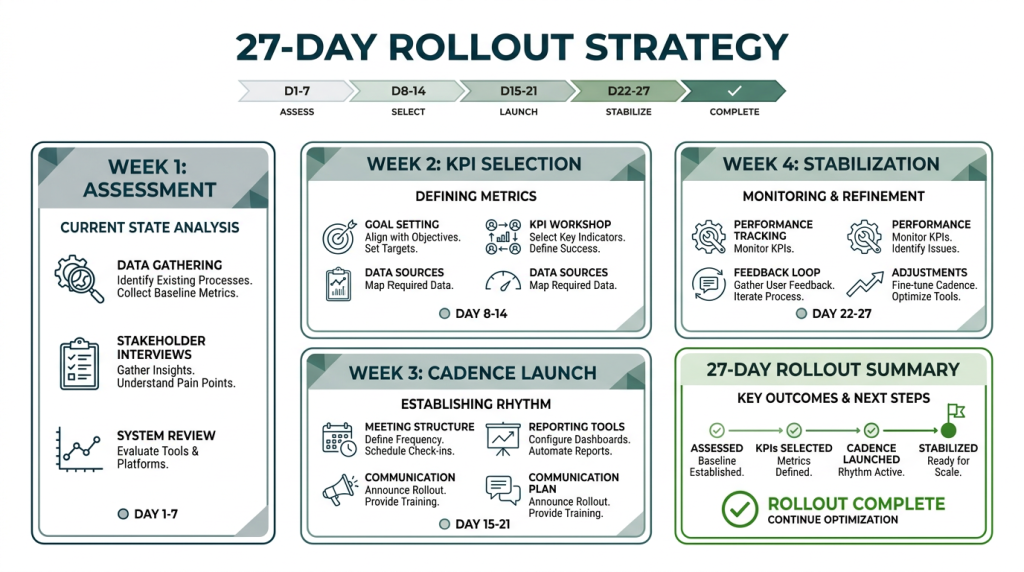
Stand Up an Operating Rhythm in 27 Days (2/12)
Once you've identified your growth bottlenecks, the next move is building the structure that keeps your team focused and accountable week over week. Without a repeatable cadence, even the best diagnosis fades into noise.
A fractional COO can install this rhythm fast. Amazon's Weekly Business Review model, which many high-growth operators borrow, centers on a consistent meeting cadence tied to input metrics your team can actually control. Bain's research on executive team meetings adds another layer: separating "run the business" reviews from strategic discussions prevents meetings from collapsing into one long, unfocused conversation.
- Install a Weekly Business Review (WBR), Monthly Business Review (MBR), and structured 1:1s within the first 27 days.
- Lock 5–7 core KPIs per function so teams know exactly what moves the needle and what doesn't.
- Use the MBR format to review performance narratives, not just dashboards, so context travels with the numbers.
- Start a decision log from day one so every call made in a meeting is recorded, owned, and revisited.
- Tie each KPI to a named owner, so accountability is clear and handoffs between teams stop leaking.
This kind of operating rhythm is exactly what FinUp Partners' fractional COO services are built to install quickly, as seen in their WorkIt field engagement, where centralized information hubs and structured check-ins drove measurable cross-functional alignment. Get this foundation in place, and the next step, bridging leadership gaps without full-time hires, becomes significantly easier.
Bridge Leadership Gaps Without Full-Time Hires (3/12)
When your operations are outpacing your leadership capacity, the instinct is to hire. But a full-time C-suite hire takes months to recruit, onboard, and orient — time most scaling founders don't have. A smarter move is placing a fractional COO or CFO to own cross-functional execution from day one. Research published in 2024 confirms that interim executives bridge leadership gaps most effectively when engagements include structured onboarding, clear success metrics, and a defined exit plan. That's exactly how FinUp Partners's fractional COO services are built — to unblock teams fast, not just advise from the sideline.
The goal isn't to create a dependency on outside leadership. It's to build capability inside your org while the fractional executive runs point. That means backfilling with player-coach directors who handle day-to-day execution while the fractional leader drives strategy. Practical guidelines from interim leadership research support a lifecycle approach: set explicit scope at the start, transfer knowledge throughout, and define exit criteria before the engagement begins. When you structure it this way, your team leaves stronger — not dependent on someone who won't be there full-time.
Deploy Interim C-Suite for the Raise (4/12)
A fundraising round doesn't fail in the meeting room. It fails in the weeks before, when the data room is incomplete, the model can't defend itself, and governance is an afterthought.
A fractional CFO or COO steps in to own the raise end-to-end, so you stay focused on running the business while someone experienced drives the workback.
- Build the data room early — cover financials, cap table, contracts, and the documents investors flag in Series A diligence before they ask.
- Own the financial model — prepare scenario-based projections and a 13-week cash forecast your team can defend in any investor conversation.
- Tighten board-ready reporting — clean, consistent updates reduce friction and signal to investors that governance is already in place.
- Run a focused 6–8 week investor sprint — maintain weekly target lists and follow-ups, and prioritize likely closers to build momentum fast.
- Align the narrative to the numbers — the story and the model need to tell the same version of the business, with no gaps for doubt to fill.
When the fundraising workback has a real operator behind it, you walk into investor meetings with confidence rather than scrambling to patch gaps. With that foundation in place, the next step is making sure your engagement structure can flex as the raise evolves.
Use Flexible Engagement to Match Your Pace (5/12)
One of the biggest advantages of fractional executive engagement is that it bends to your business, not the other way around. As HBR notes, the best fractional arrangements are titrated over time: you define the work, set clear accountability, and adjust intensity as priorities shift. That means ramping a fractional COO from a few days a month to near-embedded during a fundraise, then tapering back to light-touch governance once the round closes and the operating rhythm holds.
Protecting your burn rate through this process comes down to time-boxing. Treat high-intensity sprints as a deliberate investment with a defined end date, not an open-ended commitment. A World Economic Forum analysis of 200 startups found that the ones who scaled successfully built operational resilience in focused, milestone-driven phases rather than sustaining peak effort indefinitely. The same logic applies here: match executive capacity to where the business actually needs it, and you get the output without the overhead.
Engineer Cost-Effective Executive Capacity (6/12)
The cost advantage of fractional leadership is real, but it is not automatic. It comes from how you structure the engagement. Pair a senior fractional executive who sets direction with mid-level operators who own day-to-day execution, and you get enterprise-grade output without the enterprise-grade payroll.
As HBR notes, the arrangement works best when you define the work, set priorities upfront, and hold every hour accountable to a deliverable rather than a seat at the table.
- Blend seniority levels — let a fractional COO set strategy and direction while player-coach directors own day-to-day execution.
- Target a 3–5x ROI within 90 days — tie the engagement to revenue growth, margin improvement, or extended cash runway from the start.
- Tie every hour to a deliverable — scope engagements to specific outcomes via FinUp's C-suite service model, not open-ended advisory retainers.
- Avoid all-strategy spend — if the fractional executive isn't implementing, recalibrate the scope before the next billing cycle.
- Review the scorecard monthly — track what moved and cut what didn't; HBR's guidance on interim leadersemphasizes clear objectives and KPIs as the single biggest driver of measurable stabilization outcomes.
When you treat fractional capacity as a capital-efficient investment rather than an overhead line item, you get real execution without real overhead. That discipline sets you up to build systems that scale well beyond the engagement itself.
Install Proven Systems from High-Growth Environments (7/12)
The mistake most founders make is importing enterprise processes wholesale and wondering why the team grinds to a halt. The better move is selective borrowing. A fractional COO brings battle-tested frameworks from companies like Amazon and Starbucks, then right-sizes them for your stage. Think lightweight SOPs for sales-to-delivery handoffs, not 40-page policy manuals. FinUp's field engagement work shows how a focused rollout, built around pilot testing and cross-functional support, drove adoption across 3,400 users without overwhelming the team.
The same discipline applies to how you define accountability. Tiered SLAs give every team member a clear picture of response expectations without requiring a management layer to enforce them. Pair that with a RACI chart at each handoff point, and you eliminate the "I thought they owned it" conversations that quietly kill delivery speed. The goal isn't process for its own sake. It's removing ambiguity so your team can move faster, not slower.
Make Finance Investor-Ready—Before They Ask (8/12)
Investors don't lose confidence during due diligence because your numbers are bad. They lose it because your numbers are unclear. Getting your financial house in order before the first meeting changes the entire tone of a raise.
A fractional CFO will standardize your core SaaS metrics — MRR/ARR, churn, CAC/LTV, and cash runway — so every number has a clean, defensible definition and every stakeholder is reading from the same sheet.
- Align on metric definitions first: sloppy MRR calculations and inconsistent churn rates are red flags that slow deals down.
- Build a 24-month model with three scenarios — base, upside, and downside — so you can defend assumptions, not just headline numbers.
- Run sensitivity analyses on burn rate and revenue growth to show investors you understand your own risk.
- Target a 78%+ on-time close rate for monthly reporting by end of quarter — consistency here signals operational maturity.
- Lock a board-ready reporting cadence so updates are predictable, not reactive.
Clean financials don't just satisfy investors — they sharpen how you run the business day-to-day. With this foundation in place, your operations and product loops can do what they're designed to do: compound growth.
Accelerate Product-Market Fit with Ops Feedback Loops (9/12)
Most founders treat product-market fit as a product problem. It's actually an ops problem. Your support queue, sales call notes, and NPS scores are live signals telling you what's working and what isn't. Route those into a weekly PM/ops review and you create a decision engine. Research from First Round maps PMF across measurable dimensions like satisfaction, demand, and efficiency — all of which show up first in frontline data, not product analytics. A fractional COO can own that cadence so nothing gets lost in the noise.
From there, the discipline is simple: ship small, track impact, cut what doesn't move the numbers. NPS alone explains 20–60% of organic growth variance, making it a reliable early signal for retention and expansion. Pair that with the Sean Ellis 40% benchmark to gut-check whether your core users would genuinely miss your product. Any project that doesn't improve retention, margin, or cycle time gets cut. That discipline is what separates early traction from a repeatable growth engine.
Tighten Cross-Functional Handoffs to Boost Efficiency (10/12)
Operational efficiency for startups often breaks down not within teams, but between them. The handoff points, where sales passes to delivery, or delivery passes to support, are where work stalls, gets duplicated, or quietly falls apart.
A fractional COO's first move is usually to map the end-to-end process as it actually runs today, not how it looks on paper. From there, the fixes become obvious.
- Map your current-state workflow across every function to surface double entry, rework, and idle wait time.
- Define acceptance criteria at each handoff point so teams know exactly what "done" looks like before passing work forward.
- Assign clear ownership at every transition using a simple RACI to remove ambiguity and speed decisions.
- Automate your top two highest-volume repetitive workflows, such as data entry or status updates, before adding headcount.
- Review handoff failure points biweekly and retire workarounds that have become permanent fixtures.
Clean handoffs compound quickly. Once teams know what good looks like at every transition, cycle times drop and rework shrinks without adding a single person to the payroll. With execution running more smoothly, the next step is making sure your fractional leaders are pulling toward the same growth targets as the rest of the business.
Align Fractional Leaders to Growth OKRs (11/12)
A fractional executive without a direct line to company-level OKRs is just an expensive side project. The fix is straightforward: pull their goals directly from the CEO's top priorities, not from a separate agenda. As WhatMatters recommends, senior executives should own 1–3 objectives maximum, each tied to a shared key result that cuts across functions. Set quarterly targets with named owners for revenue, margin, and velocity metrics, so accountability is visible and non-negotiable.
Knowing what to measure is only half the job. Reviewing it often enough to act on it is the other half. A MIT Sloan analysis of OKR adoption found that teams running biweekly check-ins course-correct faster and hit targets more consistently than those relying on quarterly reviews alone. Build a standing biweekly review of leading indicators, not just outcomes, so your fractional leader can spot drift early and adjust before it compounds into a bigger problem.
Measure Executive Impact in 90 Days (12/12)
Bringing in a fractional executive without defining what success looks like is a fast way to waste money and momentum. The 90-day window is where you find out whether the engagement is working — but only if you've set the right benchmarks from day one.
Start by agreeing on the outcome before the work begins. Whether that's a funding milestone closed, an on-time delivery rate above 78%, or a measurable lift in gross margin, the target needs to be specific, owned, and visible to everyone involved. Y Combinator's guidance on startup metrics recommends anchoring to 4–5 outcome-focused KPIs and avoiding vanity metrics that show activity without showing progress.
- Define success upfront by naming the exact milestone — funding closed, SLA hit, margin improved — before the engagement starts.
- Build a one-page scorecard with four columns: baseline, target, actual, and owner — reviewed every two weeks.
- Lock in leading indicators so you can course-correct at week 30, not week 90, when it's too late.
- Make the renewal decision on outcomes, not on hours logged or slide decks delivered.
- Document what worked so the operating knowledge stays in the business after the engagement ends.
As Fast Company notes, executives who define clear priorities before starting drive measurably faster results — the same principle applies when you're the one setting the mandate. Renew, rotate, or exit based on the scorecard. That discipline is what turns a fractional engagement into a repeatable model for scaling your team.
FAQ: Fractional Executives and Scaling
If you're considering bringing in fractional leadership, you likely have a few pointed questions before you commit. The answers below cut straight to what founders actually need to know about how these engagements work, what to expect early on, and how to know if it's paying off.
How is a fractional executive different from a consultant or advisor?
A consultant diagnoses and recommends. An advisor opines. A fractional executive owns outcomes. As HBR notes, part-time senior leaders embed in your business and carry execution responsibility, not just advice. They run your weekly business reviews, unblock your teams, and are accountable to your KPIs.
What deliverables can I expect in the first 30 to 90 days?
In the first two weeks, expect a structured assessment of your biggest operational constraint. By day 30, you should have a clear 90-day plan with owners and milestones. By day 90, the focus shifts to a functioning operating rhythm, cleaner cross-functional handoffs, and measurable progress on the priority you hired them to fix. FinUp Partners has documented this kind of phased delivery in practice, including in field engagement work where early pilots drove stakeholder buy-in and repeatable execution models within weeks.
How do I budget and measure ROI for a fractional COO or CFO?
Start by tying the engagement to a specific outcome: a funding milestone, an improvement in delivery reliability, or a reduction in churn. Target a 3 to 5x return within 90 days against that outcome. HBR's framework recommends asking what success looks like before you sign. The engagement cost is a fraction of a full-time salary, so the bar for positive ROI is lower than most founders expect.
When does a fractional executive make more sense than a full-time hire?
When the need is real but time-bound. If you're in a fundraising sprint, scaling a new delivery function, or fixing an operational bottleneck, a fractional leader gets you moving in days, not months. You avoid the recruiting lag, the equity dilution, and the fixed overhead. FinUp Partners' C-suite services are built around exactly this kind of agile business transformation, where the scope adjusts as your needs shift.

Scale Smarter—Make Your Next 90 Days Count
The gap between selling and executing is where most startups stall. Closing it doesn't require a full-time C-suite hire. It requires the right operator, a clear mandate, and 90 days. Research from Harvard Business Review confirms that companies who build integrated operating systems, combining clear KPIs, cross-functional governance, and continuous feedback, grow more consistently and command stronger valuations. A structured 90-day plan gives you the sequencing to get there without chaos.
Start with a two-week assessment, lock your priorities, and build toward outcomes you can defend in a board room. FinUp Partners deploys real operators who install these systems at startup speed, so your business executes on rhythm, not heroics.
Ready to stop firefighting? Get FinUp Partners' Fractional COO Services and make your next 90 days count.