

How to Scale Startup Operations Efficiently and Avoid Common Growth Pitfalls
Author: Carla Anderson Skogland, Founder & Partner - FinUp Partners
I used to think scaling meant more of everything - more hires, more tools, more meetings. Then I realized I'd simply scaled my chaos. Efficient growth comes from fewer, clearer systems, not more noise. The most successful scale-ups master operational discipline before they hit the accelerator.
Key Takeaways
- Establish foundational operating systems—decision rhythms, documented workflows, and actionable metrics—before accelerating growth to ensure scalable and predictable operations.
- Avoid common growth pitfalls such as premature specialization, tool sprawl, and ramping demand before delivery capacity is proven, as these can quietly undermine efficiency and burn runway.
- Align your fundraising, pricing, and product roadmap with operational realities by tying investment and pricing to measurable capacity gains and real unit economics, not vanity metrics.
I'll share the exact playbook I use as a Fractional COO to help founders scale startup operations efficiently. You'll get the rhythms, frameworks, and decision rules that keep quality high while growth accelerates. Connect with FinUp Partners to access Fortune 100-caliber operators who've guided 200+ startups through similar growth phases.

Build the Operating System Before You Floor the Gas
In my first 90 days as a fractional COO, I typically find the same pattern: brilliant founders who can sell and build product, but whose teams spend 60% of their time on rework and firefighting. When founders ask me how startups can build scalable processes to support rapid growth, the answer isn't hiring faster or buying more software. It's installing three foundational systems: decision rhythm, workflow documentation, and metric accountability. Get this right, and growth becomes predictable instead of chaotic.
Create Decision Rhythm at Three Speeds
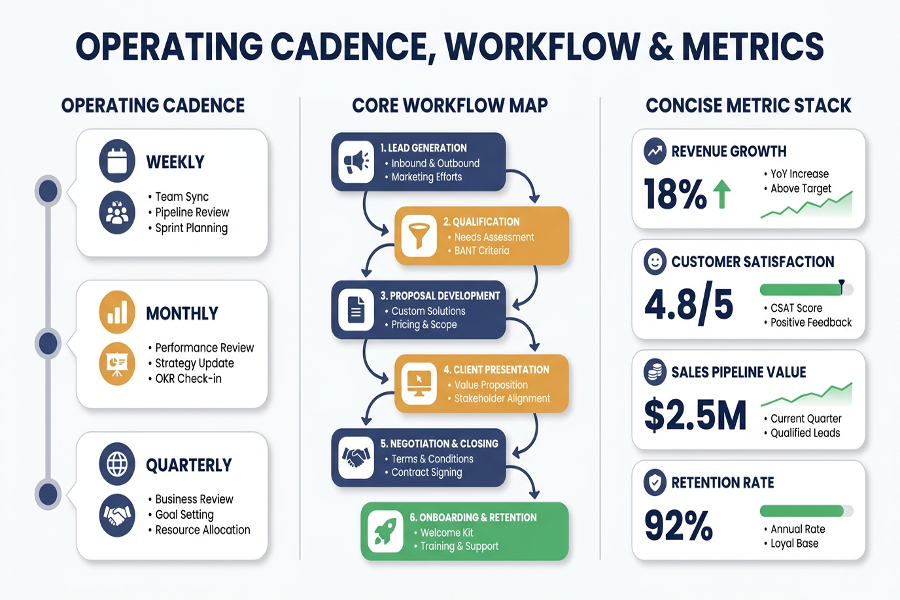
Your team needs predictable moments to make decisions, not endless meetings. I recommend weekly executive sync for immediate blockers, monthly reviews for performance trends, and quarterly resets tied to runway and capacity. HashiCorp's cadence framework shows how this structure prevents bottlenecks without bureaucracy. Each session has a specific owner, agenda, and outcome. This rhythm ensures decisions happen consistently, not just when crises force them.
Document Revenue-Driving Workflows First
Start with the 3-5 core processes that directly generate revenue and retain customers. Map your lead-to-customer journey, incident resolution steps, and onboarding sequence. Define ownership, service level agreements, and handoff points. Cross train team members to eliminate single points of failure—when your top salesperson goes on vacation, deals should still close. Our C-Suite services help founders transform these ad-hoc processes into repeatable systems that work without constant oversight.
Instrument Four Metrics That Drive Action
Track quality (churn rate), speed (cycle time), cost (unit economics by cohort), and reliability (on-time delivery). Each metric needs an accountable owner and a decision threshold. When churn exceeds 8% monthly, who acts? When cycle time hits 14 days, what changes? Reforge's framework demonstrates how successful teams tie metrics directly to behavior changes. In my experience with 40+ startups, companies that instrument these four areas see 30% fewer escalations within six months.
Avoid the Traps That Quietly Kill Efficiency
I've watched too many founders fall into traps that feel like progress but actually slow everything down. Research from McKinsey* shows that 78% of scale-ups fail to maintain their growth trajectory, often because they mistake activity for efficiency. The three biggest operational challenges I encounter are:
- Premature specialization. Don't create teams faster than you create process. I've seen founders hire a RevOps specialist before they've documented their lead handoff process, or stand up a DevOps team while deployments still require manual coordination. Stand up shared services only after you've stabilized your first cross-functional workflow and proven consistent throughput. Get one process humming before you improve ten.
- Tool sprawl over process clarity. Add new software only if it replaces two manual steps and has a clear owner. I use a simple rule: if a tool doesn't change a decision or behavior within 30 days, sunset it. Premature scaling often shows up as buying solutions for problems you haven't properly defined yet. Your communication tools shouldn't have more integrations than you have documented workflows.
- Scaling demand before delivery. This scaling challenge creates the most damage because growth metrics look healthy while operations crumble underneath. Resist ramping paid acquisition or sales headcount until your delivery SLA is consistent for 70% of customers and onboarding cycle time has improved by at least 63% from baseline. Use these thresholds to greenlight growth investments. I've helped companies avoid burning through runway by establishing these gates before they scale their go-to-market engine.

Align Fundraising, Pricing, and Roadmap With Your Operating Reality
When you're preparing to raise, investors want to see how their money translates to measurable capacity gains. Build board-ready reporting that connects specific hires to performance improvements. For example, show how adding three SREs reduces incident response time by 40%, enabling enterprise SLAs that unlock higher-tier pricing. The YC guide emphasizes mapping dollars to concrete milestones. Anchor your raise to operational metrics, not vanity numbers. Your roadmap should prioritize features that reduce onboarding time, support load, or churn before building additional product features.
Beyond fundraising alignment, your pricing strategy must also reflect operational realities. Price according to your actual delivery model, not what competitors charge. If enterprise features require higher support ratios, create tiered SLAs and implementation fees to protect margin. Test pricing against your true unit economics through accurate financial modeling that includes support costs per customer segment. These effective strategies to scale startup operations without sacrificing quality recognize that reliability directly impacts customer acquisition costs. When your delivery is consistent, customers stay longer and refer others, making quality improvements a growth lever rather than just a cost center.