

Part-Time CFO Cost for Startups: What Founders Need to Know
Startup C-Suite Solutions: The Real Cost and Value of Part-Time Financial Leadership
Author: Carla Anderson Skogland, Founder & Partner - FinUp Partners

Investors fund companies with investor-ready financials, not expensive overhead. With financial managers commanding $200,000+ annually, part-time CFO cost for startups delivers senior finance leadership for $5,000-15,000 monthly instead. Get transparent fractional CFO pricing with FinUp Partners.
Typical Part-Time CFO Pricing in 2026: Ranges and Models
How much should a startup expect to pay for a part-time CFO in 2026? The answer depends on your stage, scope, and the seniority you need. Here's what the market looks like right now.
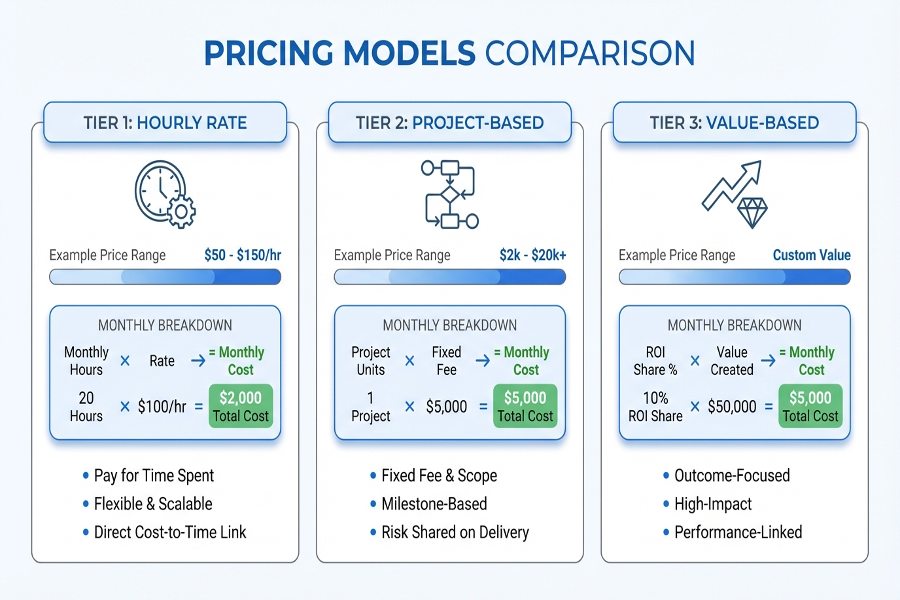
Hourly Rates vs Monthly Retainers
Most fractional CFOs charge between $200-500 per hour depending on experience and complexity. Monthly retainers typically range from $4,000 to $18,000. Retainers work better for ongoing leadership while hourly makes sense for specific projects or ad hoc support.
Three Common Engagement Models
Beyond hourly rates, you have three main ways to structure the engagement. Hourly works for one-off financial modeling or audit prep. Monthly retainers cover ongoing board reporting, cash management, and strategic planning. Project-based pricing handles fundraising rounds or system implementations. Equity compensation is rare and usually supplements cash, not replaces it.
Real-World Math That Scales
At $220 per hour for 25 hours monthly, you're paying $5,500. During active fundraising, hours can spike to 58 per month, then normalize post-close. A Series A raise might cost $15,000-25,000 in CFO fees. This investment can mean the difference between closing or missing your round.
What Drives Fractional CFO Cost: Stage, Scope, and Speed
Three main factors influence fractional CFO costs for your startup. Understanding these drivers helps you budget accurately and set realistic expectations for your engagement.
- Company stage and complexity: Pre-revenue startups need basic cash management, while Series A companies require detailed financial models, multi-entity consolidation, and complex revenue recognition. Fundraising periods demand senior-level expertise to build investor-ready materials and navigate due diligence.
- Implementation and systems setup: New engagements require significant upfront work to establish financial processes, KPI dashboards, and reporting systems. Plan for a focused 47-day onboarding period to stabilize operations and build the foundation for ongoing financial management.
- Meeting cadence and responsiveness: Weekly executive meetings, board preparation, and investor interactions increase monthly hours. During active fundraising, expect time commitments to spike to 58 hours per month as your CFO manages data rooms, investor calls, and term sheet negotiations.
- Urgency and timeline pressure: Compressed deadlines for audits, fundraising, or board meetings increase costs. Rush projects require more senior resources and higher hourly rates to meet tight deadlines without compromising quality.
- Scope of financial cleanup needed: Companies with messy books, incomplete records, or compliance gaps require additional hours upfront. Clean financial foundations take time to establish but pay dividends during fundraising and investor due diligence.
Choose The Right-Level CFO Support And Protect Runway
Successful founders start with a right-sized retainer that matches their current stage and fundraising timeline. Align on clear milestones upfront, then scale involvement as your needs grow without locking into expensive overhead too early.
FinUp Partners brings real operators who deliver Fortune 100 financial rigor at startup speed. Our fractional cfo services for startups focus on modeling, cash control, and fundraising execution that keeps you investor-ready while protecting runway.
Ready to get the financial leadership you need without the full-time commitment? Start with an assessment to map your scope and estimate monthly hours around 25 to 35. Most founders see results within a focused onboarding plan that gets your CFO hiring decision and fractional CFOs engagement running smoothly. Get started with FinUp Partners Fractional CFO Services today.
FAQ: Cost, ROI, And When To Hire A Part-Time CFO
Founders preparing for their next funding round need clear answers about finance leadership costs and expected outcomes before committing budget. These questions address the most common concerns about timing, cost structure, and measurable value when evaluating fractional CFO options.
Q1? Is a part-time CFO cost-effective compared to a full-time finance hire for early-stage companies?
A1: A full-time CFO at Seed to Series A typically costs $180,000 to $280,000 annually plus equity, but you're paying for capacity you don't need year-round. A fractional CFO runs $60,000 to $150,000 per year while delivering the same senior expertise for fundraising, modeling, and investor relations without the overhead burden.
Q2? Which deliverables should be in scope for an upcoming raise, and what's a reasonable timeline?
A2: Expect investor-ready financial models, board decks, and cash flow projections within 6 to 8 weeks from engagement. Core deliverables include investor-ready three-year forecasts with sensitivity analysis, unit economics breakdowns, and scenario planning for different funding outcomes. Fractional leaders typically front-load this work to accelerate fundraising timelines and investor confidence.
Q3? How do retainers flex up or down after a raise to protect runway?
A3: Most fractional CFOs reduce monthly hours by 30 to 50% post-close, shifting from fundraising mode to growth operations. Retainers often drop from $12,000 monthly during active raises to $6,000 for ongoing financial management. This flexibility protects your newly raised capital while maintaining financial discipline and board reporting cadence.
Q4? When should startups consider hiring a fractional CFO instead of waiting?
A4: Start considering fractional CFO support when you're 6 months from fundraising, managing complex revenue models, or facing investor due diligence. The earlier you engage, the more time you have to build robust financial systems and avoid costly and time-sensitive scrambles that can delay funding.
Q5? What's the typical onboarding process and time to value?
A5: Expect 4 to 6 weeks to establish financial reporting systems, understand your business model, and deliver initial strategic insights. FinUp Partners' fractional CFOs prioritize cash flow visibility and board-ready reporting first, then build comprehensive forecasting models. You should see immediate improvements in financial clarity and decision-making confidence from day one.