

What Does a Fractional CTO Do? A Practical Guide for Startup Founders
Author: Kari Escobedo, Fractional CTO & CIO, FinUp Partner

Key Takeaways:
- A fractional CTO delivers part-time, executive-level technology leadership that aligns your product and systems with growth and investor expectations—without the cost or commitment of a full-time hire.
- Fractional CTOs focus on measurable business outcomes, including scaling architecture, managing technical debt, and implementing security controls that directly impact revenue, fundraising, and customer retention.
- Engagements are scoped around clear deliverables and milestones, with typical costs and structures outlined, helping founders address critical technology risks and accelerate growth efficiently.
Sixty percent of startup funding delays stem from unresolved technology risks that investors spot during due diligence. Your product works, your team ships features, but scaling risks emerge. Here's what investors actually scrutinize: Can your architecture handle 10x growth? Will technical debt slow your roadmap? Are your security controls ready for enterprise customers?
A fractional CTO provides part-time executive technology leadership tied to business outcomes, not project-based consulting. Unlike consultants who advise, fractional CTOs implement systems that balance speed, stability, and cost. They're ideal for non-technical founders and lean teams facing scale, technical debt, or investor scrutiny. FinUp Partners connects founders with proven CTO and CIO operators who have scaled technology at companies like Microsoft and Amazon. Ready to align your tech strategy with your growth targets?
Core Fractional CTO Responsibilities and Outcomes
Founders often wonder how technology leadership translates into measurable business impact. The right fractional CTO responsibilities connect directly to your revenue goals, delivery timelines, and investor confidence rather than just managing code and servers.
What specific decisions will a fractional CTO make in the first 90 days?
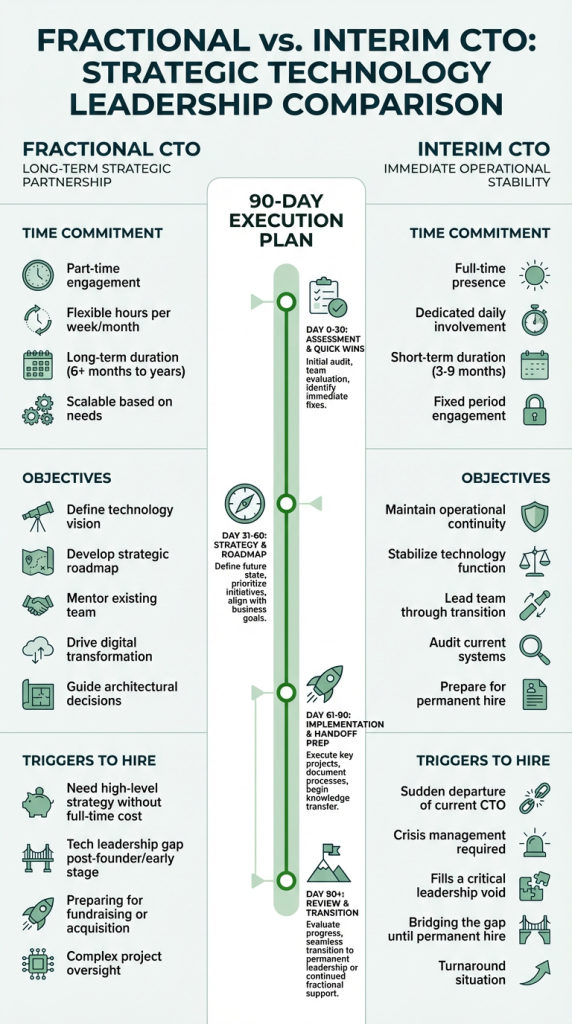
The first 30 days focus on delivery risk assessment and team structure evaluation. Days 31-60 involve implementing DORA metrics for deployment frequency and lead time tracking. Days 61-90 center on technical debt prioritization and security posture improvements. Each phase includes board-ready progress reports with measurable outcomes.
Which engineering metrics should they track and report to the board?
The five DORA metrics provide the foundation: deployment frequency, lead time for changes, change failure rate, and recovery time. These metrics demonstrate team velocity and reliability that investors care about. Monthly board reports include uptime percentages, feature delivery against commitments, and security incident summaries without confusing board members.
How do they balance paying down technical debt with shipping new features?
Experienced fractional CTOs allocate 20-30% of engineering capacity to technical debt using dedicated improvement tracks that protect infrastructure work. They identify debt that directly impacts customer experience or team velocity first. The Umbrex playbook recommends protected time slots that prevent feature pressure from overwhelming system improvements.
How does a fractional CTO connect technology decisions to revenue and growth metrics?
A fractional CTO maps feature releases to customer retention targets and ties infrastructure investments to cost-per-acquisition goals. They track how page load times affect conversion rates and how API reliability impacts churn. Technology roadmaps become revenue roadmaps with clear ROI projections.
What role do they play in security and compliance for fundraising?
Fractional CTOs establish SOC 2 readiness pathways and implement data governance frameworks that satisfy enterprise customer requirements. They create incident response playbooks and vendor security assessments that investors expect during due diligence. Security becomes a competitive advantage rather than a compliance checkbox, opening doors to larger deals and higher valuations through proven CTO leadership.
Engagement Model, Cost, and When To Hire
Founders facing budget constraints and investor scrutiny need clear answers about fractional CTO pricing, time commitment, and timing before making this investment. These questions address the practical decisions that determine whether a fractional engagement delivers measurable results or becomes a misaligned investment.
What are typical engagement levels, and how do you scope results?
Most fractional CTOs work 1-3 days per week, with engagements ranging from 8-24 hours monthly. Results get scoped around specific deliverables like product roadmaps, security audits, or team scaling plans rather than open-ended consulting. According to MRI Network, fractional roles focus on part-time strategic leadership while interim roles provide full-time operational coverage during transitions.
How much does a fractional CTO cost, and what drives pricing?
Fractional CTOs typically cost $8,000-$25,000 per month, depending on experience level, engagement intensity, and deliverable complexity. Senior operators with Fortune 500 backgrounds typically charge higher rates, while scope creep and undefined outcomes can inflate costs. Negotiate fixed monthly fees tied to specific milestones rather than hourly rates to control spend.
When should you hire an interim CTO instead of a fractional CTO?
Choose an interim CTO when you need full-time leadership to fill a vacancy during major transitions like acquisitions or departures. Fractional CTOs augment your existing leadership team with strategic guidance while your team handles daily operations. Interim roles replace missing leadership; fractional roles enhance existing capabilities without displacing internal ownership.
What signals indicate it's time to hire a fractional CTO?
Hire when technical decisions directly impact fundraising, customer retention, or product delivery timelines. Red flags include repeated missed deadlines, security concerns blocking enterprise deals, or technical debt threatening system stability. Wait if your primary challenges are sales, market fit, or team culture rather than technology execution.
How do you structure a 90-day fractional CTO engagement?
Define three 30-day milestones with measurable outcomes like completing a technical audit, delivering a scaling roadmap, or implementing security controls. This aligns with proven frameworks for delivering tangible results in 90 days. Set exit criteria upfront: either transition to a full-time hire, extend the engagement, or complete the defined scope. Include weekly check-ins and monthly board updates to track progress against business goals.
Scaling Tech Teams, Architecture, and Risk Management
Growing your engineering team and technology infrastructure directly impacts your ability to close funding rounds, retain customers, and hit revenue targets. These decisions determine whether your technology accelerates growth or becomes a bottleneck that stalls your next milestone.
How should a fractional CTO structure engineering teams as they grow from 5 to 35 people?
With 5-13 engineers, hire senior developers who can mentor and set coding standards. At 13-25, add your first engineering manager and split the platform from product teams. Beyond 25, introduce team leads and specialized roles like DevOps engineers. The BVP scaling guide provides detailed hiring sequences for each growth stage.
What architecture decisions help startups scale traffic without runaway cloud costs?
Start with auto-scaling groups, database read replicas, and CDN caching early. Use managed services like RDS and Lambda to reduce operational overhead. Set billing alerts at 80% of the budget and monitor cost per transaction. The AWS Well-Architected framework prevents costly architectural rewrites that can derail product roadmaps.
What does a practical 90-day technical debt remediation plan look like?
First, audit code quality and identify security vulnerabilities that risk customer trust. Next, fix performance bottlenecks that impact user experience and churn rates. Finally, implement automated testing to prevent future debt accumulation. Allocate 20% of development time to debt reduction while maintaining feature velocity that drives revenue growth.
Which security controls are required for SOC 2 readiness and enterprise deals?
Start with multi-factor authentication, encrypted data storage, and access logging. Document incident response procedures and conduct quarterly security reviews. Establish data retention policies and vendor risk assessments. The AICPA SOC 2 framework defines control requirements that enterprise customers expect during security evaluations and can unlock higher-value contracts.
How does a fractional CTO improve vendor management and incident response?
Negotiate SLAs with uptime guarantees tied to revenue impact. Create runbooks for common failures and establish escalation procedures. Implement monitoring that alerts before customers experience problems. Conduct monthly vendor reviews to assess performance and identify backup options. FinUp Partners' fractional CTO services help establish these systems without full-time executive overhead.
Next Steps: Put Fractional CTO Leadership To Work
A fractional CTO connects your technology roadmap directly to revenue targets and growth milestones. They reduce delivery risk by implementing proven systems that balance speed, stability, and cost as you scale. Fractional leaders deliver senior expertise without full-time overhead, making them ideal for startups facing technical challenges during fundraising or rapid growth.
To capture these benefits, FinUp Partners deploys real CTO and CIO operators with hands-on experience from companies like Microsoft and Amazon. Start with a 90-day plan that includes clear metrics for roadmap delivery, system reliability, and security posture. This approach gives you measurable outcomes while building the technical foundation your business needs to reach the next stage.
Ready to align your technology strategy with your growth goals? Explore our Fractional CTO/CIO services and get started with FinUp Partners today.