
When Should a Startup Hire a Fractional CCO for Revenue Growth?
7 indicators on when to bring in a head of growth
Author: Carla Anderson Skogland, Founder & Partner - FinUp Partners
Your product-market fit appears strong and ARR is climbing, but deals keep stalling in late stages. Pricing decisions become gut-feel choices rather than systematic pricing models. Unclear ICP definition and inconsistent sales processes rank among the top GTM challenges founders face during growth phases.
This disconnect between product traction and revenue predictability signals a deeper issue. Fractional executives have become the go-to solution for startups seeking experienced operators without full-time overhead, especially when preparing for fundraising rounds that demand credible revenue narratives. Wondering when should a startup hire a fractional Chief Commercial Officer (CCO) to bridge this gap?
FinUp Partners deploys proven commercial operators who transform growth potential into predictable revenue streams.

7 Clear Signs You're Ready for a Fractional CCO
Revenue grows in fits and starts while deals slip away. Your team debates strategy during pipeline reviews. These seven scenarios signal experienced commercial leadership should step in to align your go-to-market engine around predictable growth.
#1. Our ARR is $1–5M and growth feels choppy-can a fractional CCO stabilize our pipeline?
Yes. Choppy growth at this stage often stems from misaligned messaging, unclear ICP, or pipeline management gaps. Experienced commercial leaders bring proven systems to smooth out revenue bumps. They'll audit your funnel, fix conversion leaks, and establish predictable growth patterns without full-time overhead.
#2 Sales, marketing, and product can't agree on our ICP-should a fractional CCO unify our go-to-market now?
Absolutely. When teams pull in different directions, deals stall and marketing spend gets wasted. This leader acts as the strategic anchor, using data to define your true ICP and align all teams around it. Most see immediate improvements in campaign performance and sales efficiency within 30 days.
#3 We're fundraising soon-how does a fractional CCO strengthen our revenue story?
Investors want predictable, scalable revenue growth backed by solid unit economics. They'll build the narrative around your market opportunity, growth trajectory, and path to profitability. Clean forecasts, defendable assumptions, and milestone clarity become your competitive advantage during funding conversations.
#4 Our demos look great but win rates stay flat-can a fractional CCO remove late-stage friction?
Yes, this signals classic conversion problems. Strong demos that don't close point to pricing confusion, competitive positioning gaps, or proposal process issues. Win-loss analysis reveals where deals die, leading to redesigned closing processes that typically improve qualified lead conversion by 15-20%.
#5 Our pricing and packaging feel wrong - when should we bring in commercial leadership for a reset?
When pricing becomes a frequent objection or you're unsure how to package new features. Pricing mistakes kill growth momentum or leave money on the table. Strategic commercial leadership will analyze your value proposition, test pricing hypotheses, and design packages that maximize both conversion and revenue per customer.
#6 Customer acquisition costs keep rising but we don't know why - can fractional leadership diagnose the problem?
Rising CAC without clear attribution indicates channel mix problems or targeting drift. Commercial leaders will audit your entire acquisition funnel, from top-of-funnel spend to closed-won analysis. They identify which channels drive quality customers and reallocate budget accordingly, often reducing CAC by 25-30% within 60 days.
#7 Our sales cycles are getting longer and we can't figure out what changed-should we bring in outside expertise?
Lengthening sales cycles often reflect competitive pressure, feature gaps, or process friction that internal teams miss. Fractional commercial leadership brings fresh perspective to diagnose cycle extensions. Research from First Round Review shows fractional executives excel at identifying and fixing these operational blind spots quickly.
Scope, Impact, and ROI: What a Fractional CCO Actually Does
Scaling founders need concrete proof that fractional commercial leadership delivers measurable results fast. These questions address the specific outcomes, organizational impact, and return on investment that justify bringing in senior revenue expertise when you're managing runway and growth targets simultaneously.
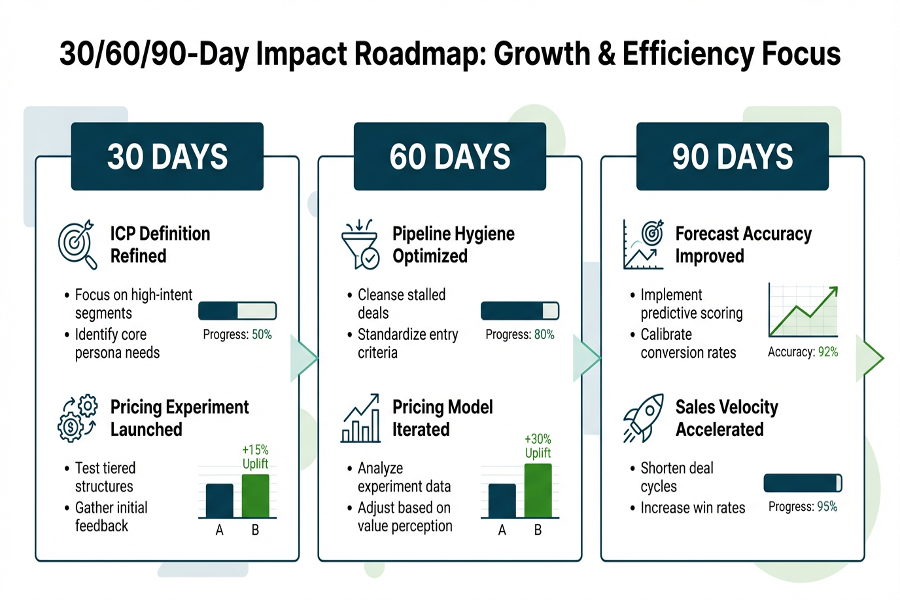
What outcomes should I see in the first 30, 60, and 90 days?
In the first 30 days, expect clearer ICP definition and improved pipeline health metrics like coverage ratios hitting 3-4x targets. By day 60, you'll see pricing experiments running-testing new packaging with 10-15% of prospects while protecting existing deals. At 90 days, win rates and sales velocity show measurable improvement.
Do they manage my sales and marketing teams directly or coach existing leaders?
Most fractional CCOs work as player-coaches, taking direct ownership of strategy and key deals while coaching your existing team leads. They guide your sales manager on scaling revenue operations and help marketing refine messaging, but work through current reporting structures without disrupting team dynamics or creating confusion.
How do I measure ROI without adding full-time headcount costs?
Focus on one primary metric: CAC payback improvement. A strong fractional CCO should reduce your blended CAC ratio by 15-25% within 90 days. Track this alongside win rate improvements and shorter sales cycles. These gains typically pay for the engagement within the first quarter of measurable results.
Can they overhaul pricing and territories without disrupting current quarter targets?
Yes, through parallel testing rather than wholesale changes. They run new pricing models with select prospects while maintaining current deals, then analyze conversion data. Territory adjustments happen between quarters. This protects in-flight revenue while building evidence for sustainable pipeline improvements next quarter.
How do they work with fractional CFOs or COOs during fundraising?
Fractional CCOs deliver specific revenue materials: unit economics models, market sizing analysis, and 18-month revenue forecasts with clear assumptions. They partner with fractional CFOs on financial projections and COOs on operational scaling plans. Together, they create investor-ready data rooms with aligned growth narratives and realistic milestone planning.
Hiring Model, Fit, and Timing: How to Engage the Right Leader
The difference between a fractional CCO who transforms your revenue engine and one who burns runway comes down to three things: the right scope, clear success metrics, and knowing when to make the call.
What weekly commitment delivers the best results for SaaS startups?
Most SaaS companies see strong results with 1-2 days per week for diagnostic and strategy work. Companies with complex enterprise sales or multiple product lines often need 3-4 days for embedded execution. Part-time senior leaders can drive meaningful change when scope matches commitment level.
What should happen in the first two weeks?
A proper diagnostic covers territory overlap analysis, competitor win/loss patterns, and deal velocity by segment. Experienced fractional CCOs run a structured go-to-market strategy audit covering messaging consistency, pricing benchmarks, and funnel friction points. This baseline drives the 30/60/90-day action plan and identifies quick wins.
What red flags indicate the wrong fractional CCO for our stage?
Avoid advisors who don't execute. Look for operators who've built sales teams at your stage and can show specific wins at similar ARR levels. Hiring the right commercial leader requires matching their background to your sales complexity and startup leadership gaps. Skip anyone pushing generic frameworks without hands-on SaaS experience.
How should we structure compensation and success metrics?
Structure monthly retainers with 30-40% tied to outcomes like improved win rates or forecast accuracy. Build in exit clauses tied to 90-day milestones. Our CMO/CGO services focus on measurable ROI, and SaaS companies benefit from KPIs around customer expansion alongside new acquisition metrics.
When should we convert from fractional to full-time?
Consider conversion when you hit $5-10M ARR with complex sales processes requiring daily leadership. Signs include managing 15+ reps, multiple product lines, or enterprise deals over $100K. Your fractional CCO should help you build the job description and interview process for their full-time replacement.
Ready to Align GTM and Drive Predictable Revenue
If these seven signs match your situation, commercial leadership for startups can bridge the gap between choppy growth and predictable revenue. Research shows companies with aligned customer-facing functions achieve 2.4x revenue growth compared to misaligned competitors. Your product-market fit is solid, but your go-to-market strategy needs an experienced commercial operator to unify messaging, pricing, and pipeline.
That's where fractional commercial leadership makes the difference. FinUp Partners deploys proven commercial leaders who deliver measurable outcomes within 90 days without full-time overhead. These operators bring Fortune 100 systems adapted for startup speed, helping you avoid costly missteps while preparing investor-ready forecasts. The right fractional CCO transforms scattered efforts into a unified growth engine that scales with your business.
Ready to stop guessing and start growing predictably? Explore our Fractional COO services to unify your brand, marketing, and sales around revenue outcomes that matter.