
When Should a Startup Hire a Fractional CTO? 7 Signs You're Ready
Author: Kari Escobedo, Fractional CTO & CIO, FinUp Partner

Key Takeaways:
- Recognizing concrete signals—such as recurring outages, mounting tech debt, and security gaps—can help startups identify when it's time to bring on a fractional CTO to address urgent technical challenges.
- Fractional CTOs deliver executive-level leadership and proven systems tailored for high-growth startups, providing measurable outcomes in areas like roadmap delivery, compliance, and fundraising readiness at a startup-friendly cost.
- A well-structured fractional CTO engagement includes a clear scope, outcome-driven metrics, and a focus on knowledge transfer, ensuring your team gains independence and your business maintains momentum through critical growth stages.
Your product roadmap is ambitious, but your last three releases shipped late. Security audits reveal gaps that could block enterprise deals. Cloud costs are climbing faster than revenue, and your engineering team keeps asking for "just one more sprint" to fix accumulating platform debt. According to MIT research, startups face a common dilemma: complexity outpaces internal capability, but full-time executive hires feel premature or unaffordable.
This timing challenge affects most scaling startups. The question isn't whether you need senior leadership—it's determining when a startup should hire a fractional CTO versus waiting for full-time leadership. Hiring too early wastes capital, while hiring too late risks product failure and missed fundraising windows. Smart founders recognize the warning signals before they become expensive problems. FinUp Partners helps scaling startups bridge this gap with proven executives who implement solutions at startup speed. Let's identify the signals that indicate you're ready.
Timing And Readiness: 7 Signs You Need A Fractional CTO
Knowing when to hire a fractional CTO comes down to recognizing specific warning signals in your technology operations. These questions reveal whether technical leadership gaps threaten your next milestone.
Are recurring outages and missed releases signaling an urgent need for senior technical leadership?
Yes, if you're seeing patterns that impact customers or slow product velocity. DORA metrics like deployment frequency and change failure rate reveal when engineering needs immediate help. A fractional CTO implements proven practices to stabilize operations and build sustainable delivery processes.
Does your product roadmap outpace your current architecture's ability to scale?
This mismatch creates a serious risk during fundraising or rapid growth. When your tech foundation can't support the business plan you're pitching, you need startup technology leadership fast. A fractional CTO aligns technical strategy with revenue goals and prevents costly system rebuilds.
Are security or compliance gaps blocking enterprise deals?
SOC 2 readiness and data governance often surprise growing startups. If prospects ask about security certifications you can't answer, these gaps get expensive to fix later. FinUp Partners' fractional CTOs implement compliance frameworks that unlock enterprise revenue quickly.
Is tech debt compressing your team's velocity despite adding engineers?
When hiring more developers doesn't increase output, technical debt has reached a breaking point. This signals when to hire a fractional CTO who can reset engineering practices. They establish code quality standards and refactoring processes that restore team productivity.
Are you making important technical decisions without the right expertise?
Non-technical founders often face choices about cloud architecture, AI strategy, or vendor selection that impact future costs. When these decisions feel overwhelming, fractional CTO support provides the technical judgment and business context you need to move forward confidently.
Scope, ROI, And Fit: Fractional CTO Vs. Full-Time CTO
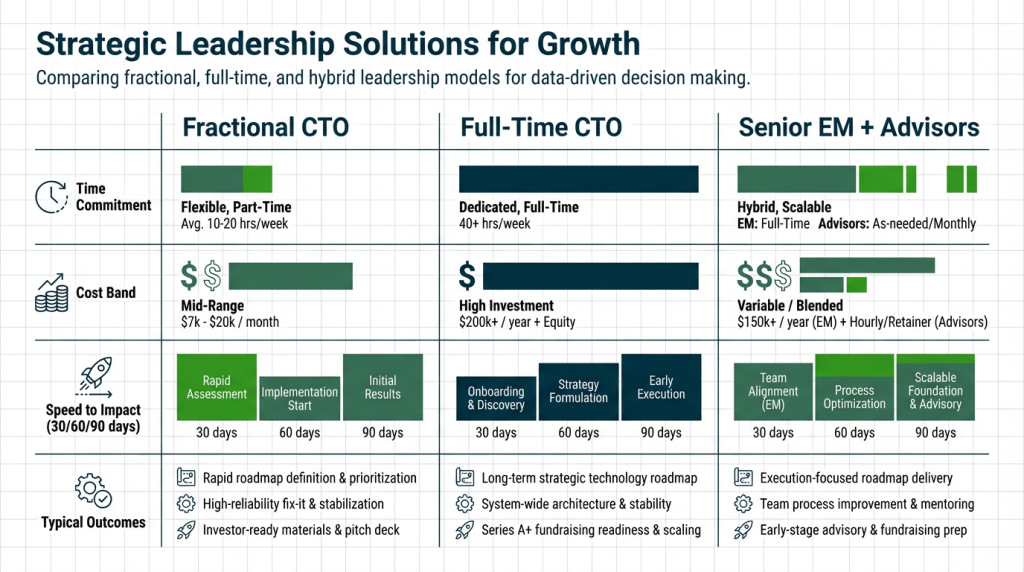
Choosing between a fractional CTO, full-time hire, or alternative approaches depends on your timeline, budget, and risk profile. For non-technical founders, these questions help you weigh costs against outcomes and determine which model fits your growth stage and fundraising plans.
What should a fractional CTO own versus my lead engineer?
A fractional CTO handles executive decisions: product roadmap alignment with business goals, architecture choices, vendor selection, and hiring standards. Your lead engineer focuses on implementation, code reviews, and day-to-day team coordination. The fractional CTO sets direction; your team executes it.
How do costs compare between a fractional CTO, a full-time CTO, and a senior engineering manager plus advisors?
A full-time CTO costs $200K-$400K annually plus equity. A fractional CTO costs $8K-$25K monthly for 1-3 days per week. Senior engineering manager plus advisors might seem cheaper at $150K-$200K total, but they lack the executive decision-making authority you need for fundraising and board interactions. FinUp Partners' fractional CTO services provide executive-level guidance at startup-friendly pricing.
When is a fractional CTO not the right fit?
Skip fractional if you need 24/7 executive coverage, deep R&D leadership, or highly regulated compliance oversight. Companies building core IP, managing complex hardware, or operating in healthcare/fintech with strict regulatory requirements typically need dedicated full-time technical leadership. For most SaaS and tech-enabled businesses, fractional provides the right balance of expertise and flexibility.
What outcomes should I expect in 30, 60, and 90 days?
Month one: roadmap clarity and architecture assessment. Month two: engineering best practices implementation and hiring pipeline. Month three: measurable improvements in deployment frequency, incident response, and technical due diligence readiness. These tie directly to faster feature delivery and reduced operational costs.
How does a fractional CTO de-risk fundraising?
Investors evaluate technical scalability, security posture, and engineering unit economics during due diligence. A fractional CTO prepares system architecture documentation, addresses tech debt concerns, and translates your technical roadmap into investor-friendly milestone projections. This preparation can accelerate funding timelines by weeks.
Engagement Model, Execution, And Measurement
You've identified the need for technical leadership, but how do you structure an engagement that delivers results without micromanaging your team? The right model depends on your stage, timeline, and biggest risks.
What engagement model works best for seed through Series B startups?
Weekly cadence works because it maintains momentum without overwhelming your team—8-12 hours per week for the seed stage gives you strategic oversight plus hands-on architecture review. Series A/B companies need 15-20 hours to handle team scaling and investor reporting. Daily check-ins create dependency; weekly builds capability. Embedded sprints work for specific projects like SOC 2 prep or API redesigns.
Which metrics prove a fractional CTO engagement is working?
Track DORA metrics like deployment frequency (aim for daily deploys within 90 days) and change failure rate (target under 15%). Monitor API uptime and response times for customer-facing reliability. Measure roadmap delivery confidence by tracking committed vs. shipped features—good fractional CTO services improve this from 60% to 85%+ within two quarters.
How should a fractional CTO work with product, finance, and sales?
They join your weekly leadership meetings and translate tech decisions into business impact. For example, they help finance model engineering costs per new customer, work with sales on technical feasibility of enterprise deals, and partner with product on feature prioritization based on technical complexity. This prevents your roadmap from promising what engineering can't deliver.
Can a fractional CTO fix legacy systems without risky rewrites?
Yes, through staged improvements that keep your product shipping. Start by adding monitoring and fixing your three biggest pain points—maybe slow database queries, manual deployments, or missing error handling. Then plan incremental changes over 6-12 months. This beats the "rebuild everything" approach that typically takes 18 months and often fails.
How do you structure knowledge transfer for team independence?
Document architectural decisions and create incident runbooks during the first 60 days. By day 90, the fractional CTO should be coaching your team rather than handling day-to-day technical decisions—your engineers own feature delivery while the CTO focuses on scaling strategy. Proper measurement frameworks and clear handoff processes make this transition smooth.
Ready To Decide? Next Steps And How To Start
Hire a fractional CTO for startups when scale, reliability, or security risks threaten your next funding round or growth milestone. The signals are concrete: missed ship dates, mounting tech debt, compliance gaps, or architecture that can't handle your roadmap.
Here's what works: FinUp Partners connects you with real operators who tie tech strategy directly to revenue goals and deliver measurable outcomes in 90 days. Before your first call, gather your current roadmap, org chart, recent incident history, and top three technical risks. As executive hiring experts recommend, define your business goals upfront, pick the right engagement model, and confirm specific 30/60/90-day metrics.
Ready to see how our CTO services for startups can accelerate your growth? Start here to connect with proven technology leaders who implement—not just advise.